Navigating the Legal Challenge in Funding for Philippine Nurses

In 2019, the Supreme Court delivered a significant ruling in Ang Nars Partylist vs. Executive Secretary, stating that “the Court cannot compel Congress to fund Section 32 of R.A. No. 9173 as the power to appropriate public funds is lodged solely in Congress. Unless Congress makes the necessary appropriation through a law, Section 32 of R.A. No. 9173 will remain an unfunded law, a situation that applies to many other laws.” This ruling underscores a crucial legal limitation: despite the existence of a law designed to enhance the compensation of Philippine nurses, this law cannot compel the government or private hospitals to increase nurses’ salaries without the necessary legislative appropriation.

At present, the monthly salary for an entry-level nurse in the Philippines hovers around 36,000 to 37,000 pesos. In stark contrast, nurses working abroad can earn between 150,000 and 500,000 pesos per month, depending on the country and the employing institution. While it might be tempting to view financial compensation as the sole factor in these decisions, many nurses opt to work internationally not just for higher salaries but also for enhanced professional growth and better overall quality of work and life.

Given that nurses are unable to leverage existing laws to compel Congress to allocate additional funds, where does this leave them? The recent passage of the Universal Health Care Act, while well-intentioned, fails to address the crucial role of nurses in ensuring accessible and comprehensive healthcare for all Filipinos. The Act’s admirable goals could risk joining the ranks of other unfunded and unmet legislation if the necessary financial resources are not allocated. As the saying goes, our country may have excellent laws, but we often falter in their implementation.

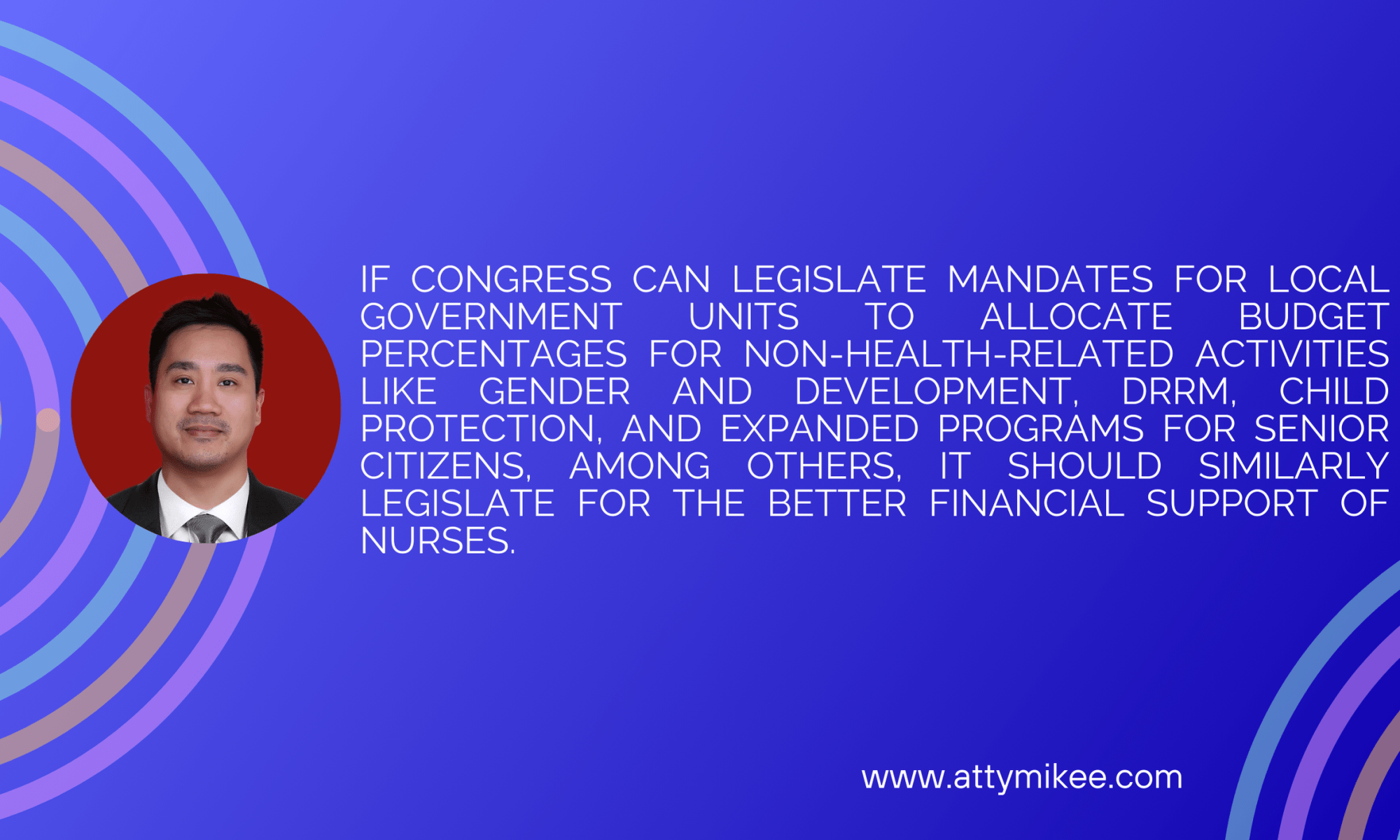
Addressing this issue requires treating nurses as a distinct class or sui generis of health workers, particularly given the current state of our healthcare system. The prevailing conditions demand that we afford nurses the consideration they deserve. While we may not be able to match the compensation offered by other countries, the government should at least develop a strategic plan to elevate the standards of the nursing profession. If Congress can legislate mandates for Local Government Units to allocate budget percentages for non-health-related activities like gender and development, DRRM, child protection, expanded programs for senior citizens, among others, it should similarly legislate for the better financial support of nurses. This does not need to be achieved within a single year; a phased approach to improving the financing of our frontline healthcare workers could result in substantial benefits.

We cannot expect nurses to fully support the goals of universal health care without addressing their own needs. Extending greater compassion to this vital profession is not merely a gesture of goodwill but a necessary step, as nurses are often the last individuals to provide care in our final moments.
Ethics on the Edge: Nurses Exploiting Patients for Social Media Content

During the Crimean War, Florence Nightingale did not exploit the wounded for personal gain or publicity. Although social media did not exist at the time, she had the option to use the press but chose not to. Instead, Nightingale used the lamp to symbolize her commitment to the nursing profession, rather than resorting to modern tools like selfies or cameras. Her focus was not on self-interest or public attention but on providing compassionate care to the sick and injured. Florence Nightingale became the Mother of Nursing because of her selfless acts.

She was passionate about her Environmental Theory not about her public image.

Fast forward to today, many, though not all, nursing students are using their patients as digital content on social media. Recently, I was shocked to learn that a nursing student recorded the dying moments of a patient—specifically, “the precise time when the electrocardiogram reading flatlined”—and then uploaded this video footage to a public social media account. The post went viral and garnered widespread attention from people in the healthcare profession.

Florence Nightingale must be turning in her grave.

The nursing profession is not a normal occupation. It is imbued with public interest, and it has cultural, professional, and moral underpinnings. In fact, the Board of Nursing passed Board Resolution No. 220, Series of 2004 or the Promulgation of the Code of Ethics for Registered Nurses to enforce a body of ethical standards or norms for Filipino Nurses.

Section 1 of the Code of Ethics provides that — The Filipino registered nurse, believing in the worth and dignity of each human being recognizes the primary responsibility to preserve health at all costs. It is expanded by Section 8 of the same Code of Ethics, in this wise: Nurses must Respect Patients’ Bill of Rights in the delivery of nursing care. One of the patient’s bill of rights is the right to privacy and respect.

Registered nurses are aware that their actions have professional, ethical, moral, and legal dimensions. They strive to perform their work in the best interest of all concerned and to carry out their duties under existing laws, rules, regulations, and generally accepted principles of moral conduct and proper decorum.

During my first week of nursing study at West Visayas State University, it was impressed upon us that the focus of nursing care is always the patient. Theoretical foundations of nursing practice, particularly those advocated by Dr. Jean Watson, emphasize that nursing should consider the whole person.

A dying person remains a person, and a nursing student should use his or her time to either prevent death or assist the patient in achieving a comfortable and peaceful end. I cannot understand how posting on social media could be a priority during such a critical moment.

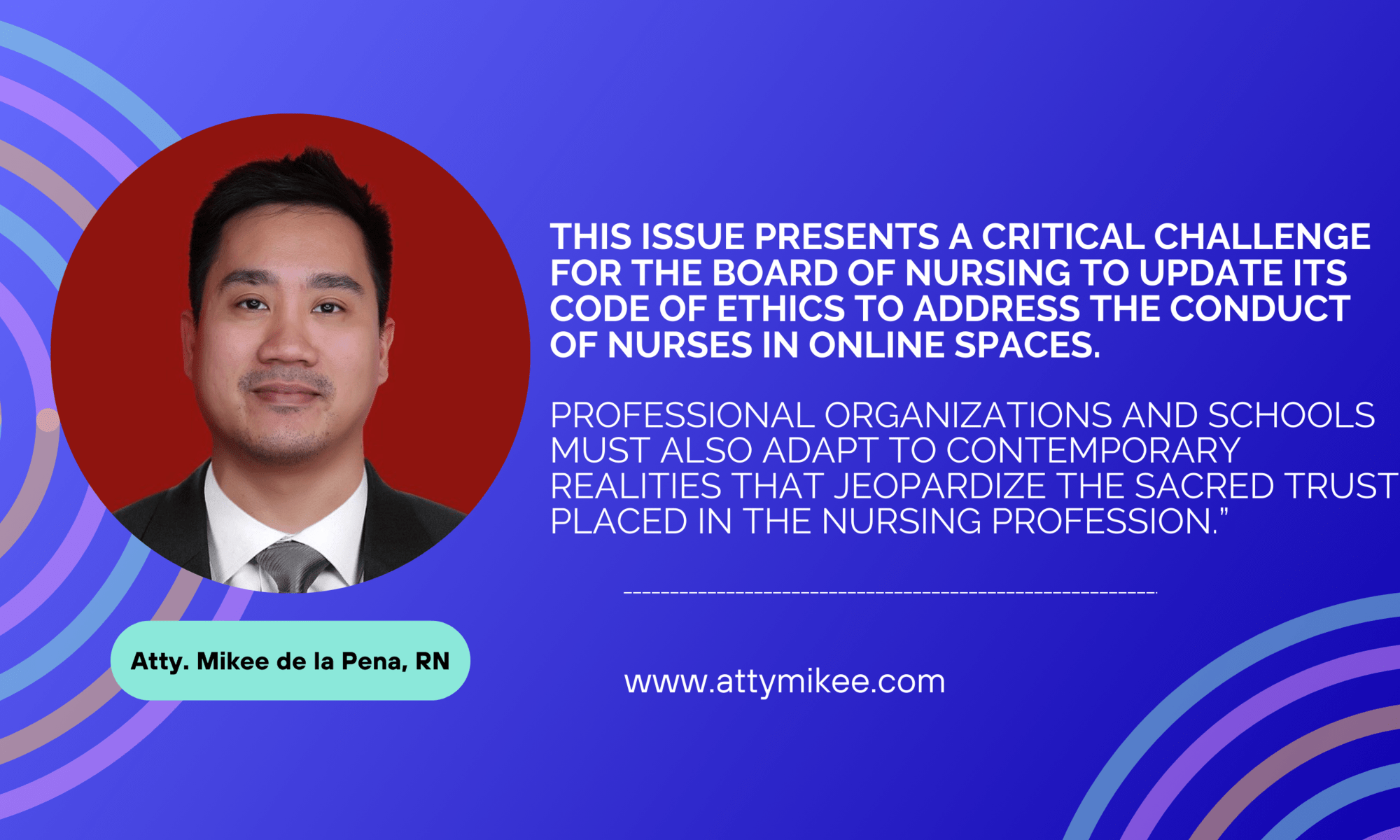
This issue presents a critical challenge for the Board of Nursing to update its Code of Ethics to address the conduct of nurses in the online realm. Professional organizations must adapt to contemporary realities that jeopardize the sacred trust placed in the nursing profession. Filipino nurses are renowned for their compassion and competence, which is why the Philippines remains a leading exporter of nursing talent globally. We cannot allow narcissistic tendencies to tarnish this esteemed profession.

It is imperative that we collectively work to uphold and elevate the standards of nursing, ensuring that our actions reflect the true spirit of care and professionalism.

Finally, our nursing schools should prioritize not only developing the skills of nursing students but also shaping their attitudes.

About the Author:

Michael “Mikee” De la Peña is both a lawyer and a nurse, currently serving as a policy officer at a health think tank in the Philippines.

In his legal practice, he manages cases related to civil and criminal litigation, non-profit law, health policy, and intellectual property rights. He is also pursuing a Master of Laws degree at Ateneo de Manila University, focusing on Intellectual Property Law and Health Governance.