Understanding Informed Consent in Medical Cases

I. Introduction

The Supreme Court’s decision in Elpidio Que v. Philippine Heart Center et al. crystallizes two pillars of medical malpractice jurisprudence in the Philippines: the precise contours of the “standard of care” and the exacting demands of informed consent. By denying the petition of the Que family and absolving Dr. Adventura of liability, the Court reaffirms that procedural rigor both in diagnosis and communication can insulate a practitioner from charges of negligence, even when a patient’s outcome is tragically adverse.

II. Factual and Procedural Synopsis

  • In mid-1999, Quintin Que was diagnosed with a coronary aneurysm. Dr. Adventura, then Head of Surgery at the Philippine Heart Center, performed a three-vessel coronary-artery bypass.
  • In October 1999, the physician proposed a cutting-edge stenting procedure, described to the family as “virtually risk-free.” The family provided written consent.
  • On February 14, 2000, under the hands of a visiting Belgian specialist, Mr. Que underwent stenting. He never regained consciousness and succumbed to a catheter-induced stroke on February 27, 2000.
  • The trial court and the Court of Appeals dismissed the Que family’s malpractice suit for failure to establish duty-breach causation. The family’s petition was filed with the Supreme Court.

III. Doctrinal Foundations

  1. Standard of Care
    Medical malpractice is, at its core, negligence. Under Cayao-Lasam v. Spouses Ramolete, the duty of care is measured against what “ordinarily trained medical professionals” would do under like circumstances. Absent proof of deviation from accepted medical practice, adverse outcomes even fatal ones do not, ipso facto, establish liability.
  2. Informed Consent
    Rooted in Schoendorff v. Society of New York Hospital and refined in Canterbury v. Spence, the doctrine mandates that physicians disclose all “material risks” those a reasonable patient would deem significant in clear, nontechnical language. Consent must be both knowing and voluntary; any material omission that, had it been disclosed, might have altered the patient’s decision will vitiate the practitioner’s defense against liability.

IV. Court’s Reasoning

  1. Duty and Breach
    The Court examined the consent record and corroborating affidavits. Dr. Adventura’s notes and the family’s signed consent form explicitly referred to the small but real risk of death. By documenting these discussions at the time of care, the physician satisfied the disclosure mandate and thus breached no duty.
  1. Causation
    The fatal stroke was traced not to negligent catheter manipulation but to an inherent biomechanical risk of any endovascular intervention. Expert testimony confirmed that the complication rate for such strokes though low falls within the known risk profile of stenting. Because the adverse event lay within the ambit of disclosed risks, causation of harm by negligence was deemed absent.

VI. Practical Implications

  1. Enhanced Consent Protocols
    • Use standardized checklists that itemize even rare and serious complications.
    • Use plain-language summaries and visual aids to reinforce verbal explanations.
  2. Robust Medical Records
    • Record not only what risks were disclosed but also the patient’s questions and responses.
    • Timestamp and initial each entry immediately after the discussion.
  3. Ongoing Professional Development
    • Train clinicians in communication skills, emphasizing empathy and clarity.
    • Conduct periodic audits of consent practices to identify gaps in patient understanding.

VII. Conclusion

Elpidio Que v. Philippine Heart Center delivers a clear message that is technical proficiency must be matched by meticulous communication. Ultimately, the ruling advances a dual objective: protecting patients without freezing the evolution of medical practice.

Sources: G.R. No. 268308 (Supreme Court)
Understanding Qualified Trafficking in Persons in the Philippines

Case Spotlight: People of the Philippines vs. XXX
Ponente: Associate Justice Paul Hernando | Date Decided: January 22, 2025

This week, we take a closer look at a significant ruling from the Supreme Court involving the protection of minors under our anti-trafficking laws.

The case involves two 14-year-old girls who were recruited by the accused to work as massage therapists in a spa, an establishment allegedly known for offering “extra services” to clients. According to the defense, the minors voluntarily sought employment, and the accused neither coerced them nor trained them to provide such extra services. Instead, she claimed to have simply provided standard massage training.

The Regional Trial Court found the accused guilty of Attempted Trafficking in Persons, noting that although the minors managed to escape before being fully exploited, the circumstances already pointed to a clear intent to traffic.

On appeal, the Court of Appeals modified the conviction to Qualified Trafficking in Persons, recognizing the involvement of minors and the gravity of the offense. The penalty was increased to life imprisonment, along with monetary damages amounting to millions of pesos.

Still insisting on her innocence, the accused elevated the case to the Supreme Court, arguing that she had no malicious intent and that her actions were merely meant to help the minors find work.

But the High Court was unequivocal.

In rejecting the appeal, the Court emphasized that the consent of a minor is never a valid defense under Republic Act No. 9208, as amended by RA No. 10364. It stated:

“A minor victim’s knowledge or consent is rendered meaningless due to the coercive, abusive, or deceptive means typically used by perpetrators of human trafficking. Even absent these means, a minor’s consent is not considered freely given.”

The Supreme Court affirmed that the accused was guilty of Qualified Trafficking in Persons, reiterating key legal principles:

  1. When the victim is a child, trafficking is qualified, which carries harsher penalties.
  1. Actual exploitation does not need to occur, recruiting minors for the purpose of sexual exploitation is already a consummated crime.
  2. Trafficking can be committed even without force or deception if it takes advantage of a child’s vulnerability.

Quoting the Court:

“Recruitment, transportation, transfer, harboring, adoption or receipt of a child for the purpose of exploitation shall be considered trafficking in persons even without any of the means stated under the law.”

“Republic Act No. 9208 does not require the victims to be actually subjected to prostitution or sexual exploitation for the crime to be complete. The act of recruitment with intent to exploit is enough.”

This decision reinforces the strong protective stance of the law when it comes to minors and serves as a reminder that the crime of trafficking begins not at the moment of abuse, but at the moment of intent and recruitment.

📚 Read the full decision here:
🔗 People of the Philippines vs. XXX (G.R. No. 273990)

Navigating the Legal Challenge in Funding for Philippine Nurses

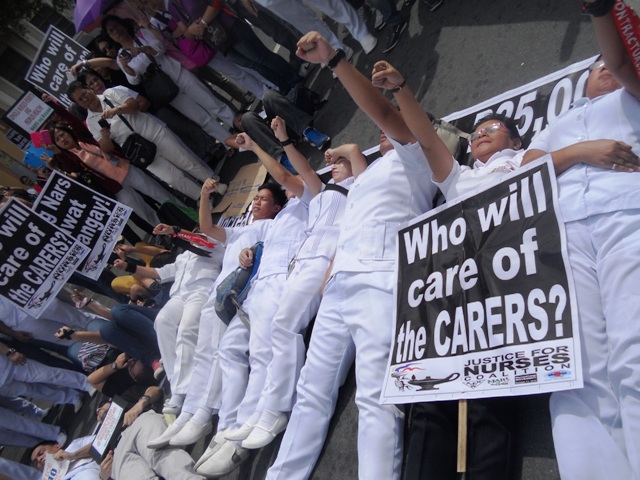
In 2019, the Supreme Court delivered a significant ruling in Ang Nars Partylist vs. Executive Secretary, stating that “the Court cannot compel Congress to fund Section 32 of R.A. No. 9173 as the power to appropriate public funds is lodged solely in Congress. Unless Congress makes the necessary appropriation through a law, Section 32 of R.A. No. 9173 will remain an unfunded law, a situation that applies to many other laws.” This ruling underscores a crucial legal limitation: despite the existence of a law designed to enhance the compensation of Philippine nurses, this law cannot compel the government or private hospitals to increase nurses’ salaries without the necessary legislative appropriation.

At present, the monthly salary for an entry-level nurse in the Philippines hovers around 36,000 to 37,000 pesos. In stark contrast, nurses working abroad can earn between 150,000 and 500,000 pesos per month, depending on the country and the employing institution. While it might be tempting to view financial compensation as the sole factor in these decisions, many nurses opt to work internationally not just for higher salaries but also for enhanced professional growth and better overall quality of work and life.

Given that nurses are unable to leverage existing laws to compel Congress to allocate additional funds, where does this leave them? The recent passage of the Universal Health Care Act, while well-intentioned, fails to address the crucial role of nurses in ensuring accessible and comprehensive healthcare for all Filipinos. The Act’s admirable goals could risk joining the ranks of other unfunded and unmet legislation if the necessary financial resources are not allocated. As the saying goes, our country may have excellent laws, but we often falter in their implementation.

Addressing this issue requires treating nurses as a distinct class or sui generis of health workers, particularly given the current state of our healthcare system. The prevailing conditions demand that we afford nurses the consideration they deserve. While we may not be able to match the compensation offered by other countries, the government should at least develop a strategic plan to elevate the standards of the nursing profession. If Congress can legislate mandates for Local Government Units to allocate budget percentages for non-health-related activities like gender and development, DRRM, child protection, expanded programs for senior citizens, among others, it should similarly legislate for the better financial support of nurses. This does not need to be achieved within a single year; a phased approach to improving the financing of our frontline healthcare workers could result in substantial benefits.

We cannot expect nurses to fully support the goals of universal health care without addressing their own needs. Extending greater compassion to this vital profession is not merely a gesture of goodwill but a necessary step, as nurses are often the last individuals to provide care in our final moments.

Ethics on the Edge: Nurses Exploiting Patients for Social Media Content

During the Crimean War, Florence Nightingale did not exploit the wounded for personal gain or publicity. Although social media did not exist at the time, she had the option to use the press but chose not to. Instead, Nightingale used the lamp to symbolize her commitment to the nursing profession, rather than resorting to modern tools like selfies or cameras. Her focus was not on self-interest or public attention but on providing compassionate care to the sick and injured. Florence Nightingale became the Mother of Nursing because of her selfless acts.

She was passionate about her Environmental Theory not about her public image.

Fast forward to today, many, though not all, nursing students are using their patients as digital content on social media. Recently, I was shocked to learn that a nursing student recorded the dying moments of a patient—specifically, “the precise time when the electrocardiogram reading flatlined”—and then uploaded this video footage to a public social media account. The post went viral and garnered widespread attention from people in the healthcare profession.

Florence Nightingale must be turning in her grave.

The nursing profession is not a normal occupation. It is imbued with public interest, and it has cultural, professional, and moral underpinnings. In fact, the Board of Nursing passed Board Resolution No. 220, Series of 2004 or the Promulgation of the Code of Ethics for Registered Nurses to enforce a body of ethical standards or norms for Filipino Nurses.

Section 1 of the Code of Ethics provides that — The Filipino registered nurse, believing in the worth and dignity of each human being recognizes the primary responsibility to preserve health at all costs. It is expanded by Section 8 of the same Code of Ethics, in this wise: Nurses must Respect Patients’ Bill of Rights in the delivery of nursing care. One of the patient’s bill of rights is the right to privacy and respect.

Registered nurses are aware that their actions have professional, ethical, moral, and legal dimensions. They strive to perform their work in the best interest of all concerned and to carry out their duties under existing laws, rules, regulations, and generally accepted principles of moral conduct and proper decorum.

During my first week of nursing study at West Visayas State University, it was impressed upon us that the focus of nursing care is always the patient. Theoretical foundations of nursing practice, particularly those advocated by Dr. Jean Watson, emphasize that nursing should consider the whole person.

A dying person remains a person, and a nursing student should use his or her time to either prevent death or assist the patient in achieving a comfortable and peaceful end. I cannot understand how posting on social media could be a priority during such a critical moment.

This issue presents a critical challenge for the Board of Nursing to update its Code of Ethics to address the conduct of nurses in the online realm. Professional organizations must adapt to contemporary realities that jeopardize the sacred trust placed in the nursing profession. Filipino nurses are renowned for their compassion and competence, which is why the Philippines remains a leading exporter of nursing talent globally. We cannot allow narcissistic tendencies to tarnish this esteemed profession.

It is imperative that we collectively work to uphold and elevate the standards of nursing, ensuring that our actions reflect the true spirit of care and professionalism.

Finally, our nursing schools should prioritize not only developing the skills of nursing students but also shaping their attitudes.

About the Author:

Michael “Mikee” De la Peña is both a lawyer and a nurse, currently serving as a policy officer at a health think tank in the Philippines.

In his legal practice, he manages cases related to civil and criminal litigation, non-profit law, health policy, and intellectual property rights. He is also pursuing a Master of Laws degree at Ateneo de Manila University, focusing on Intellectual Property Law and Health Governance.

The “Reid effect” at its best.

Be fearless in the pursuit of what sets your soul on fire.

I became a fan since 2010 when he first appeared in PBB Teen Clash.  I am not fond of chasing celebrities except when it is James Reid.

He is one-of-a-kind, an irreplaceable atom,  who has a unique identical quantum mechanical state. He has this form of energy that can brew inspiration into meaningful actions. The bottom line is, he can place you into motion.

I call this as the “James Reid effect.

For almost 6 years, I communicated with him through my quantum universe (an alternate universe that only I can comprehend and experience).

This universe is safer compared to the universe we were born to live; there, I can manipulate things and thoughts freely without entailing cost and judgement of anyone. There, I got to see persons such as James who helped shape my judgement and my demeanor when the time calls for it.

Giving you concrete examples:

When deadlines are approaching and when anxiety is escalating, I would result to searching for his picture from any source available and pin it on my desk, at the end of the day, I am always amazed on how these little, funny things and activities gave me the energy to “do good for myself and for others.”

In times of heated arguments and troubles, my relaxants are his songs.

When I am about to sleep, my last activity is always to watch his videos.

During difficult times, his sweet, distant smile is one of my motivations.

Yesterday, I got the chance to meet him and the encounter crystalized my positive evaluations of him.

No  existing word in our lifetime (even in the combined dictionary of Webster and Merriam) can describe that moment. Some symptoms include blurring of vision and chest tightness, others are already uncanny, you have to experience it yourself.

My favorite concept in chemistry is the “Pauli exclusion Principle” by Austrian physicist Wolfgang Pauli in 1925, he states that no two particle cannot occupy the same space. I see this applicable because no matter what, James will always occupy that quantum space in me, whatever the circumstances and the conditions will be.

Experience the “James Effect” today.

-Mutya


Walang masungit na nurse kung walang CORRUPT.

During the budget hearing of the Department of Health an unsolicited and off scurrilous remark was raised placing into contempt the hardworking healthcare professionals, specifically nurses in public hospitals. The statement has no basis, tainting the caring image of the nurses.

The spirit of nursing is caring. It is in the nature of every nurse to be understanding and to be patient to everyone who is committed to her/his care. In fact, it is enshrined in the nursing curriculum to inculcate the science and art of caring in every nursing student. You can’t graduate and pass the nursing board exam without these prerequisites.

Like other professionals, nurses are also human being. Nurses are not saints or demi-gods. Their natural sparks and healing hands have limitations and expiration especially if abused. A hungry and ill-paid nurse have all the right to become grumpy, it is within the ambit of rational behavior of a human being.

Being peevish  if you are abused is normal and acceptable compared to being corrupt– siphoning the money of the country for his or her own self-interest aside from doing nothing but sitting in a chair waiting for the next election to happen– a satanic act, worthy of lethal injection.

The statement overgeneralizing nurses is but an uncanny statement, an attempt to weaken the movement of nurses towards equitable and more humane working condition in the country.

With due all respect, without implication of malice, I believe that there are more corrupt politicians compared to impatient nurses. If we are going to study the scenario, nurses sometimes become irritated because of the ineffectiveness of the government to fix the healthcare system. The lean and beggarly annual allocated budget of the government and the corruption inter alia, are the main reasons why the healthcare delivery is most of the time not ideal. Expecting for 100% of the nurses smiling all the time is stupidity.

The proposed signages in hospitals are not necessary because nurses understand the precepts of their profession. It will only entail additional costs for the health department. It would be wiser if the budget for these signages be utilized in improving the welfare of these poor nurses; a simple water dispenser or a 1 peso increase in their salary will be greatly appreciated.

If not, nurses also should place some tarpaulins in the front of every public hospitals saying:

“Walang masungit kung walang corrupt.”

“Hustisya para sa mga nurse.”

How about that?

I think it would be fair.

-Mutya

Photocredit: http://bulatlat.com/

A letter to those who ridiculed Davao after the bombing.

Dear my fellow Filipinos,

Being Filipino knows no political color, it knows no boundary, it shouldn’t hold any grudge or propagates preconceived prejudicial thoughts; more so if our fellow Filipino were caught between a catastrophic and not to say demonic act such as bombing. The bombing, I can understand but the ideology and the rancid thinking of some of our countrymen are more destructive and injurious than the bomb that exploded in Davao last Friday.

When our countrymen die, he or she carries with him a piece of our nation, and a piece of you. A part of aspiration and history are rubbed from us forever. We lose a kin, a member of our big family, who like us, hopes and dreams for a unified and peaceful nation.

How can we laugh at them? How can we judge them instead of giving our purest sympathy to the living and our prayers to the dead? No true Filipino will be jubilant while seeing his or her countrymen being bodily dismembered because of the sadistic bomb.

It is not only that the bomb separated the living and the dead in Davao but horribly it divided us into many pieces. There are some who speculates that the incident was staged, there are some who believe that there is a big plan to overtake the government and there are funny conspiracy saying that it was the government who planned the bombing.

I too, don’t know the truth. Finding the truth should only be secondary, and caring should be the priority. The truth will always come out and soon to unveil itself. But the suffering and the abused deserve a n immediate attention.

My dear countrymen, we survived super typhoons and many deadly catastrophe in history, we made it because we placed our faith into our neighbours, friends and even enemies. During these difficult times, we should try to open our hearts, adopt a positive and constructive thinking and extend our arms to those who need us.

When Paris was bombed, we immediately posted “PrayforParis” but when our country was terrorized we chose to swallow our condolences.

Maybe this is now the new characteristic of being a FILIPINO. Seeing and experiencing kindness and compassion are as fugacious as the snitch in Quidditch and genuine Filipino now is evanescent like the shooting star in our dark and vast skies.

-Mutya


Mutya applauds Sen. Hontiveros for filing Anti-Discrimination Bill.

The LGBT community has a fighter in the Senate. 

Newbie senator Risa Hontiveros filed the anti-discrimination bill yesterday in the Senate, a bold step to protect LGBT welfare in the country. 

As an LGBT advocate, I am happy and hopeful that this bill, despite not the priority of this administration, will hopefully soon becomes a law. It is needed, especially now that rampant hate crimes concerning our brothers and sisters in the LGBT community are happening all around the world. 

I believe that gender and sexuality education should also be included as one of the measures. It is through education that we can deter this discriminatory practices. 

Thank you so much Sen. Risa for making the first step. We are at your back. 

#Mutya

The Miriam inside of me.

When I was little, every time someone bullies or hurts me, without second thoughts, I would look at that person from head to toe, and admonish them in the presence of other students who are eating their packed lunches.

I became notorious for using fiery words during my elementary and high school, even until my college days though I became a bit demure and meek. My inspiration and model back then was Senator Miriam Defensor-Santiago.

Let me tell you a story.

I was in Grade 3 when I first ran as a Senator in our class elections. My adversaries back then were from Grades 5 to 6. I was the youngest and the smallest at that time—perhaps due to malnutrition. Thus, I was the last candidate to deliver my platform. I told the electorate:

“Behold, promises are made to be broken. I am asking the sky now to hit my opponents with lighting, if they are lying.”

Then a lightning struck, disturbing the solemnity of the miting de avance. On the next day, I found out that I won.  Again, my inspiration then was Sen. Miriam Defensor-Santiago.

Even during the toughest times, my faith to the Lady Senator did not falter. When there’s no food to eat, I think of it as a sign of climate change affecting food security. When there’s no electricity in our house, I think of it as a manifestation of the government’s incompetence in addressing energy problems. We seriously didn’t have proper supply of electricity until I graduated from high school.  Despite all of these, I know that Sen. Miriam was with me—pushing me to study harder and not surrender.

Here’s another story.

I was ambitious, that’s why when I was in high school, I ran as President despite contradictions because I was only in my sophomore year. There were three of us competing for the highest position in the school. I was afraid then; I was still the smallest and the thinnest. But I saw Sen. Miriam in the horizon.

I knew I needed to win.

It was a bloody speech.

At the end of the canvassing of votes, I was proclaimed President. I know that it was Sen. Miriam who made me win. However, just to note, it was my friend Alfred Dicto who became the Fidel Ramos of my life, defeating me in my second attempt for re-election.

For sure, without Sen. Miriam in my head, I wouldn’t be able to surpass all the trials in my life. She was the only person—despite the absence of many—who remained at my side. I even memorized all her speeches and I impersonate her perfectly, gaining awards by doing so.

Why am I doing this?

I already learned my lessons. Before I pursued development work, I was a nurse, taking care of critically-ill patients. I have witnessed both life and death almost every day. I learned that while you still have the chance, go and say your piece—do it now, because time is a bitch. Today, you could be sleeping in bed; tomorrow, you could be inside a coffin.

My dad passed away last year due to lung cancer, just two hours before I reached home. It was the most painful experience I’ve ever had. In my hand during that time was a poem. I wrote it while I was en route to Iloilo. I never had the chance to hug him. I failed to deliver the best care for him.

This time, I don’t know how, but I want to care for Sen. Miriam. Not only because she is a previous Senator, but because she is someone who influenced me in so many ways. I want to give her the most meticulous care she deserves. I will provide her adequate oxygenation like how she provided life and excitement in the Senate. I will monitor her electrolytes, like how she monitored the financial spending of our country. Feed her if necessary, like how she fed students with wisdom. Give her bed bath, like how she made “sabon” corrupt public officials during hearings.

And once she is already comfortable, I want to read the Constitution to her, before she sleeps.

I may be sad right now, praying ardently that the Lady Senator will soon fully recover. That God will help her because she contributed a lot to this country.

Nevertheless, I know inside of me that the Miriam spirit will always be alive—burning like a torch, ready to share the fire with everyone else.

I hope that my little story will reach you, Madam. Like how you touched my life back when I was in Grade 3.

Thank you so much.

Love,

Mutya

Paano makakuha ng True Love sa Pasig Mega Market

May nagtext, sabi niya bakit hindi ka na nagsusulat sa brightgays. I told him, “I don’t have any inspiration to write.

Medyo napatagal ang reply niya.

“Open your FB messenger.”, reply niya.

Binuksan ko naman ito at yun, lumabas ang picture niya.

Nakita ko ang Saturn, Uranus, Neptune at Pluto. Pumasok ulit ang kapangyarihan sa aking katawan. Kaya ito na susulat na ako ulit para sa mga tagasubaybay ng Brightgays.

Kahit favourite ko yung eleksyon at mga anik-anik sa politika, I will put this on the sidelines for now. This week we will explore the mysteries of the Pasig Market and how will you find meaning and love on it. Hali ka, tuklasin natin ang Pasig Palengke, ang isa sa pinakamalaking public market sa Maynila.

Ang aking  araw ay hindi kompleto kung hindi ako makakadaan sa Pasig Palengke. Ito ay compulsory para makadating sa bahay. Bagamat naiinis minsan dahil sa masangsang nitong amoy ay may mga araw ding nasisiyahan ako.

Sino-sino ang makikita sa Pasig Palengke?

Mga bruskong lalaki sa Meat Section:

Pagpasok mo sa Palengke ay makikita mo ang nagbebenta ng karne.  Kung gusto mong makakita ng mga macho at naghuhubaran na mga kalalakihan ay ito ang section na para sa inyo. Pero walang nakabra dito. Usually, ang men to women ratio sa meat section ay 9:1. Ito ay nagpapakita lang na kung karne ang pinag-uusapan unang-una ang mga lalaki. Katulad ng pag-ibig, mag-ingat ka, dahil minsan akala mo sariwa ang karne yun pala ay double dead na, sawi, naghihintay lang ng may bibili, mura, at nakakamatay. Pero huwag kang magkamali dahil matalim ang kutsilyo ng mga lalaki sa meat section. Makamandag sila.

Mga maiingat na kamay ng mga lalaki sa vegetable section:

Dito mo makikita ang mga lalaking nagbebenta ng samot saring mga gulay. Patok na patok dito ang talong, upo, sitaw at iba pa. Kung laki at haba ang batayan mo sa pag-ibig, dito ka sa vegetable section. Sabihin mo ang laki at haba na gusto mo at ibibigay nila. Napapasaya ka ba sa haba at laki ng isang pag-iibigan? Ang mga lalaki dito ay mahinhin, ang mga kamay ay maingat dahil ayaw nilang masugatan ang mga dahon at gulay. Minsan may kamahalan lang ang mga gulay nila.

Mga matatamis na ngiti ng mga lalaki sa fruit Section:

O, ngayon, kung wala pa din kayong napupusuan ay punta na tayo sa fruit section. Ito ang isa sa mga malini sa section sa pasig. Dito yata maraming mga lalaki na nakapormada, nakapaligo at mababango. Makikilala mo sila kung nakangiti sila paparating ka pa lang. Sasabihan ka na matamis ang pag-ibig nila yun pala hilaw pa. May iba naman na sasabihan ka na special ang prutas yun pala galing lang sa bakuran lang nila. Matatamis magsalita ang mga nasa Fruit section kaya pisilin niyong mabuti at maging mabusisi sa pagpili ng mga prutas. Tandaan baka artificial ang ginamit na pampahinog dito.

Iyan ang tatlo sa mga lalaki na nakilala ko sa Pasig Mega Market. May mga myembro naman ng minority block sila ang :

mga nagtitinda ng buko juice na nagpapakitang gilas sa pagbalat ng buko, pero minsan mas maraming tubig gripo Vs tubig galing sa buko,

ang mga lalaki na nagtitinda ng damit pambabae, kahit hindi bagay at maganda sa iyo ay ipipilit talaga,

ang lalaki na nagbebenta ng bigas, maraming brand, may sticky, clingy rice, meron namang mumurahin na tumitigas habang tumatagal, may black rice, may mabangong rice,

may mga lalaki ding nagbebenta ng halo-halo na pati pawis niya ay nagiging sahog na sa paninda,

at may mga lalaki na nagbebenta ng plastic kahit pinagbabawal na.

Ngayon, ipinakita ko sa inyo ang Pasig Mega Market sa ibang perspektibo. Oo, mabaho ito pero ito ang katotohanan, ang mundo at buhay ng tao ay hindi mabango sa lahat ng panahon. We have our own taste kung ano ang nakakahiligan mong kainin.

Karne ba? Gulay? Prutas? Buko Juice? Platic?

(This article is part of Mutya Perspective- using new lenses to ordinary things and events.)